
I woke up one morning in July 1983 and my parents announced that we would be leaving Lima, Peru, to seek a future in Venezuela. A few days earlier, behind our house, a Shining Path commando unit (a terrorist group) had stormed a police post. Fear and uncertainty became the backdrop of our departure.
At that time, Peru was living under the shadow of political violence. Shining Path, inspired by Maoist ideology, had declared war on the state and sought to establish a revolutionary peasant regime. Its attacks against police officers, authorities, and civilians created a climate of daily terror. The recently restored democracy was fragile, and the state’s response—often militarized—heightened the sense of insecurity. Poverty and lack of opportunity compounded the violence, pushing thousands of families to flee the country. In that context, our decision to migrate was not merely an act of seeking a better future; it was a desperate flight from an environment where life itself was threatened.
I clearly remember the airport lounge, my mother’s tears alongside my two-year-old younger sister as she said goodbye to relatives. The migration did not begin with hope, but with uprooting and pain. It was the beginning of a journey that would mark both my life and my vocation. A few days earlier, my classmates from the parish school had organized a simple but meaningful farewell. Among embraces and prayers, they handed me handwritten letters filled with affection and good wishes. Those words, kept like treasures, made me aware that I was leaving behind not only a country, but also a community that had been my spiritual and human home.
I knew my life would change radically: I was leaving behind my games, my school routines, my friends and teachers, to face an uncertain future in unknown lands. That early awareness of uprootedness accompanied me at every step, becoming the seed of a vocation that, with time, would be transformed into pastoral mission and a commitment to migrants who, like me, carry their entire world in a suitcase.
We arrived first in Bogotá and then undertook a journey along dirt tracks to Caracas. Our first home was an underground parking garage, four floors below ground, where we lived for twelve months. There I learned that human dignity can endure even in the most inhospitable places. But that journey was not without its risks. Migrating along irregular routes meant being exposed to insecurity, to the possibility of being robbed, deceived, or even losing one’s life on clandestine paths. Every step was a gamble for survival, with no guarantee of arriving safely or of finding a dignified place to live. The underground parking garage that became our home was a symbol of that vulnerability. Migration forced us to face precariousness, discrimination, and displacement, but it also taught us that human dignity can remain alive even in the midst of the most extreme adversity. It was there that I understood that migrating is not just changing countries, but traversing a path full of dangers that test the faith, hope, and resilience of the human being.
Over time we managed to move forward, though not without setbacks. Three scams struck us, but we finally managed to stabilize ourselves, establish a business, and acquire property. Migration taught us that resilience is stronger than adversity. However, it was also possible to grow within a Venezuela that, at the time, offered prosperity and opportunities. The country was experiencing an economic boom thanks to its oil resources and a social climate that allowed migrants to integrate and progress. We experienced a doorway to personal and family advancement. We were able to start businesses, work with dignity, and achieve stability, learning to value the effort and solidarity of a society that welcomed us. The experience taught us that, even after initial precariousness, migration can become a space of human and spiritual growth, where faith and perseverance are transformed into engines of hope.
Years later I entered the Order of Saint Augustine and later the diocesan seminary. Although I chose not to continue along that path, I never moved away from evangelization. I studied, married, and was ordained in an Old Catholic jurisdiction, embracing the mission as a Vetero-Catholic bishop. It was precisely in Venezuela that I discovered my life was called to service. In the midst of a society that at the time offered prosperity and opportunities, I was able to experience firsthand the needs of the poorest and most marginalized. Migration had taught me the value of solidarity, and that experience was transformed into a pastoral vocation: to accompany, educate, and sustain those who suffered displacement or poverty. From that point on, my path was always linked to social ministry, to supporting those most in need, and to the conviction that faith cannot be separated from justice and charity. Venezuela was for me not only a place of economic and personal growth, but also the space where the seed of my mission as a servant and shepherd germinated—a mission that would later be consolidated in my Vetero-Catholic episcopal ministry.
With the arrival of socialism, our economy deteriorated severely. In 2016, following a dramatic turn of events, my father was murdered. That wound compelled us to emigrate once again: first to Peru, our homeland, and then to Colombia. I understood then that no one is exempt from the experience of migration.
During those days, Venezuela was going through a crisis marked by the dramatic devaluation of the Bolívar, which wiped out families’ savings and plunged society into despair. The loss of purchasing power generated a scenario of constant theft, suicides born of desperation, and a social explosion that manifested in protests, looting, and violence in the streets. In the midst of that chaos, my father’s murder became a personal symbol of the collapse of a country that had once offered us prosperity and opportunity. The tragedy forced us to take once again the road of migration, carrying not only the pain of grief but also the certainty that life in Venezuela had become unsustainable. It was then that I understood, more clearly than ever, that migration is not a free choice, but a necessity that imposes itself when dignity and security are threatened.
My first pastoral challenge abroad came through the Teresa de Calcuta Foundation, where I had the opportunity to lead a humanitarian and educational assistance program in Bayunca, Cartagena, in the midst of the pandemic: educating 100 over-age children, most of them Venezuelan, in a place of extreme poverty. There I discovered that migration is not only a social phenomenon, but also a space of mission: a call to serve in the midst of uprootedness.
As time went on, that mission deepened. Most of the children faced hunger, unemployment, and social exclusion. Together with a group of volunteers, we took on the risk of going house to house, delivering study guides to our children so that education would not stop despite the lockdown and the lack of technological resources. That experience taught me that social ministry is not confined to temples, but is embodied in the streets, in humble homes, and in the silent dedication of those who serve. It was a time of sacrifice and hope, in which I discovered that the true mission of the migrant missionary bishop is to stand beside the most vulnerable, sustaining their faith and dignity in the midst of adversity.
Today, as a teacher and chaplain at Colegio Santa María de la Cruz in Medellín, Colombia, I have organized an association of Venezuelan students. We seek to strengthen their identity and provide them with tools to face the challenges of migration. Faith becomes a bridge that unites cultures and heals wounds. This initiative is not limited to academic formation; it seeks to affirm the cultural identity of young Venezuelans, helping them to recognize themselves as bearers of a history, a tradition, and an ethos that deserve to be preserved. We encourage them to be ambassadors of their culture, sharing with pride their customs, their music, their cuisine, and their way of seeing life, as a valuable contribution to the social fabric of Medellín.
At the same time, the association becomes a space for accompaniment in their daily difficulties: from the grief of uprootedness to the complex processes of legalization and adaptation in a new country. Along this path, educational ministry is transformed into a refuge of hope, where faith illuminates integration and solidarity opens doors for each migrant student to feel an active part of the community that welcomes them.
I conclude by affirming that migration is a global phenomenon that profoundly challenges both the Church and all of society. It demands that we open spaces of welcome, build networks of solidarity, and recognize that every migrant carries in their suitcase not only material objects, but an entire universe of dreams, memories, and hopes.
Migration is not a statistic or someone else’s problem: it is the human face of the pilgrim Christ made present in every displaced family, in every child seeking education, in every parent struggling for sustenance. As an Old Catholic Church, we are called to be a Church in motion, capable of going out to meet others, of accompanying them, and of transforming pain into mission.
I am proudly a migrant, a Vetero-Catholic bishop, and a missionary. My life is a testimony that migration, though painful and marked by irreparable losses, can become a path of grace and service. In every border crossed, in every community welcomed, I have discovered that faith is a bridge that unites cultures, heals wounds, and opens horizons of hope.
For this reason, I invite my brother clergy, social organizations, and all men and women of good will to join these initiatives. We need to build together spaces for formation, legal accompaniment, humanitarian support, and cultural strengthening for our migrants. Every gesture of solidarity, every shared project, every word of encouragement, becomes a seed of the Kingdom and a sign that the Church remains alive in the midst of the challenges of the contemporary world.
Migration is mission. It is an opportunity to rediscover ourselves as a universal community, to tear down walls and build bridges, to proclaim through deeds that the Gospel is good news for the poor and hope for those who walk with their world in a suitcase.
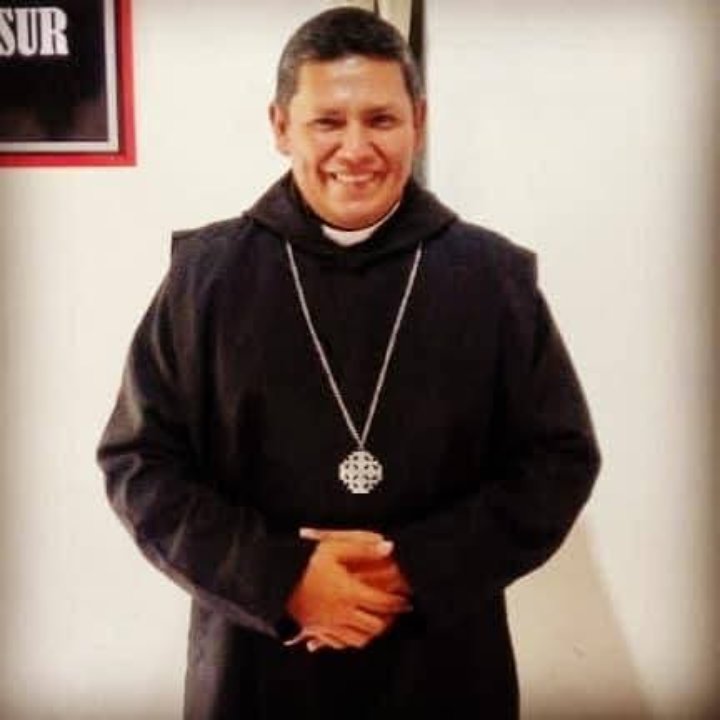
The Right Rev. Juan Carlos Mogollón Fernández is an Old Catholic bishop serving in Medellín, Colombia. Shaped by his own experience living in Peru and Venezuela, he brings a firsthand understanding of migration to his ministry, which focuses on accompanying immigrant children through the challenges of displacement. He is a living witness to the Gospel call to serve the most vulnerable.